Audit Trails for AI Agent Data Queries
Organizations building AI agents need audit trails that capture decisions, not just server logs.
When a compliance lead goes looking for answers after an AI agent incident, the logs usually show a timestamp and an API call. They do not show what the agent decided, on whose behalf, or why. That gap is the entire subject of this article: a server log records what the server did, while an audit trail records what an autonomous actor decided to do for a stakeholder, with which tools, under whose authorization. Those are categorically different questions, and most teams building agent systems today have only built an answer to the first one.
The consequence appears when a regulator or an internal auditor calls asking those questions, and the honest answer in most organizations is that they cannot fully say. That is not a failure of diligence so much as a failure of design: nobody built a system to answer that question, because nobody treated it as a different question from "did the request succeed." The gap is structural. It cannot be closed by writing more log lines in the same format, because the format was never built to carry decision context, authorization chains, or outcomes. It has to be closed by building a different kind of record, for a different kind of question, and that is what the rest of this piece works through.
The four things a defensible agent audit record must capture for every consequential action
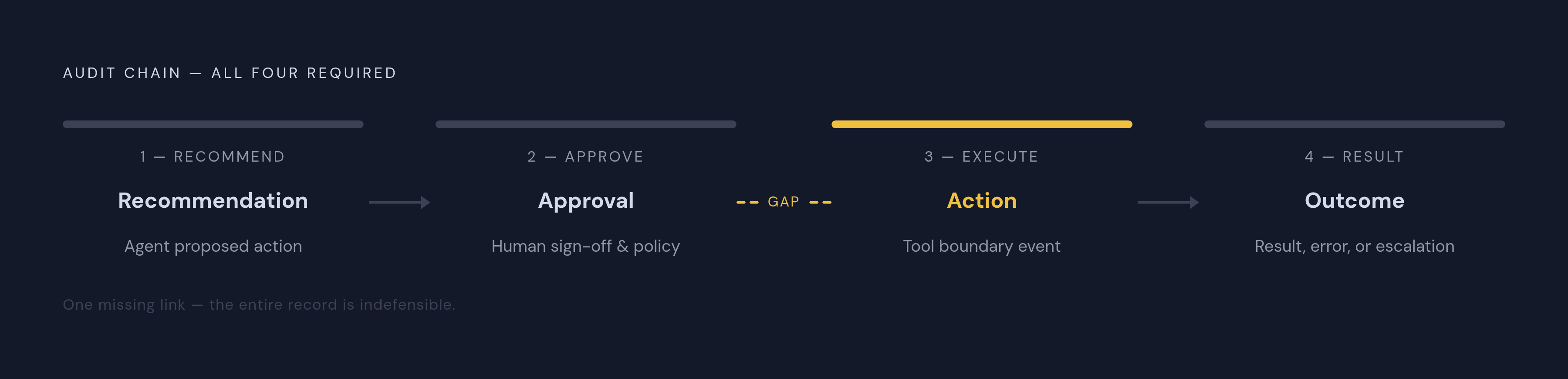
A defensible record starts with four elements for every consequential action an agent takes: the recommendation, meaning what the agent proposed; the approval, meaning which human signed off and under what policy; the action, meaning what the agent actually did at the tool boundary; and the outcome, meaning what resulted, including errors or escalations along the way. If any one of the four is missing, the record has a hole in it. A common version of this failure is a log that shows an agent escalating a decision for human review but never shows whether that help was actually given, leaving the record to imply resolution that never happened.
That four-part skeleton is necessary but not sufficient. A complete record also needs the full prompt and system prompt, including any retrieved context from a RAG pipeline; the model version and snapshot ID, not just a model name like "GPT-4"; token usage and finish reason; every tool call the agent made along with its result; the authenticated user ID and the upstream human identity behind it, not just the API key or service account; and every external data source the agent queried, along with the specific records returned. Two failures recur constantly across real implementations. The chain of identity from person to AI has to stay intact end to end, because an audit record that stops at a service account cannot tell a regulator who the system was acting for.
Model version tracking deserves its own emphasis because model behavior changes between releases, sometimes substantially, even under the same name. Capturing the full chain of identity from human to AI, including which authenticated user initiated a request and what upstream stakeholder it served, depends on the data layer itself preserving that provenance rather than letting it get flattened into a single service account entry. Platforms like Dreambase that govern datasets at the model layer and expose them through authenticated APIs make it possible for an agent's consumption of a metric or dataset to reference a specific, authorized version of that data, rather than forcing a reconstruction of identity and permissions after the fact from raw query logs.
Human-in-the-loop approval needs its own field in the record, separate from the action itself. Logging that an approval happened is a claim; logging who approved, what they saw, and what they changed is proof.
The IETF Internet-Draft draft-sharif-agent-audit-trail-06 formalizes a version of this logic through what it calls Decision Reproducibility, and the distinction it draws matters for what "replay" can honestly mean. A revision to the draft, numbered -03, added an Attestation Closure requirement specifying that digests recorded for decision reproducibility must cover the complete computational closure of the inference function: model weights, tokenizer, chat template, inference engine build, decoding configuration, and numeric environment. Any component left outside that attested set becomes a forgery channel, a gap through which a replayed decision could be made to look sound without actually matching what happened originally.
Decision reproducibility depends on the stability of the data context that supports it. Replaying a decision months later is fragile if the agent was pulling raw queries against tables whose schema has since shifted, because the "same" query against a changed table no longer tests the same decision. A governed dataset exposed to an agent as an immutable, versioned artifact makes that replay tractable: the same agent, the same model, the same dataset version, and the same authenticated context can be re-executed later to confirm the original decision was sound, because the dataset version in use at the time is still available and unchanged.
Retention and searchability also need to be specified as two separate numbers, not one. An export path that has never been exercised is an untested backup by another name. The time to discover that a compliance export format does not match what an auditor expects is not the week the auditor asks for it.
Agent Data Access Architecture and the Audit Trail
The most important fact in audit trail design has nothing to do with logging software: no amount of logging can compensate for a bad data access architecture. If an agent queries a production database directly, constructing SQL dynamically in ways that cannot be reviewed or tested in advance, the resulting trail can record that a query ran, but it cannot guarantee what data the query actually returned, what schema was in effect at the time, or whether the query modified a protected record along the way. The log is honest about the fact of the call and silent about everything that matters.
Access control enforced only at the application layer, in the form of a WHERE clause that every developer has to remember to add, is one missed line away from cross-tenant exposure. The test for any access architecture is simple to state: what happens if a developer forgets the tenant filter? If the answer is that the query returns nothing or fails outright, the architecture is sound. If the answer is that code review is supposed to catch it, the architecture already has a hole in it.
This is not only a security concern. The GDPR's data minimization principle, under Article 5(1)(c), is a direct legal requirement, not merely a best practice layered on top of security hygiene. An agent operating outside its intended scope produces unauthorized database writes and real regulatory exposure, and least-privilege access is the architectural mechanism that enforces that scope.
Governed, pre-modeled datasets solve a problem that raw production queries cannot. When an agent reads from a pre-calculated, versioned dataset instead of issuing ad-hoc SQL against live tables, the audit record can point to a stable version of that dataset. Placing a governed data layer between agents and the production database is the architectural choice that makes this possible. It is what makes the audit trail's data-source field a precise reference instead of an approximation, more than it is about query performance.
The architectural difference between logging and auditing becomes sharpest at exactly this point. If agents query production databases directly, the audit trail fragments across the database layer, the API layer, and whatever logging wraps around both, making it nearly impossible to reconstruct after the fact what regulated data the agent actually touched. Isolating agent access to a governed data layer that serves pre-modeled datasets through a controlled interface lets the audit record be built at the one boundary that matters: what the agent queried, from which authorized dataset, at which point in its reasoning. For Supabase and Postgres teams, Dreambase implements exactly this pattern, exposing pre-modeled Parquet datasets with stable version identifiers through a single MCP server rather than letting agents touch the production database directly.
MCP's stateless request model and agent audit trails at the protocol layer
Model Context Protocol has become the standard way agents connect to external data sources and tools, and that gives it outsized influence over audit trail design, because the protocol determines what information is even structurally available to capture at the moment of access. Server capabilities are now discoverable through a separate server/discover RPC instead.
That shift matters directly for audit design. Each MCP request can now be logged as a self-contained audit entry with no dependency on what came before it in the connection, which makes the resulting trail both more reliable and easier to replay independently, request by request, without needing to rebuild an entire session history to make sense of any single entry.
MCP does not make data governance automatic. MCP moves data and actions to the agent; it does not make the underlying data correct or governed. The semantic layer and the governed dataset behind the protocol are what make the connection trustworthy, not the protocol itself.
The per-tenant scoping problem that applies at the database layer applies equally at the MCP layer. The Dreambase MCP server addresses this by exposing pre-modeled, governed datasets through a single endpoint, so the MCP call that shows up in an audit log maps to a specific, versioned, tenant-scoped dataset rather than to a raw database query whose results depend on whatever state the production system happened to be in at that moment.
What the IETF draft and the regulatory frameworks require
The regulatory expectation for agent audit trails has moved from treating them as an optional feature to treating them as a baseline property of the system: captured by default on every agent action, append-only, and exportable in whatever format the relevant regulator has already chosen. The 2026 enterprise expectation is that the trail is scoped to the tenant, append-only, and ready for export in the regulator's own format, not a general-purpose log that the compliance team has to reformat by hand before submission.
The IETF draft referenced earlier, draft-sharif-agent-audit-trail-06, maps directly onto several existing frameworks: the EU AI Act, formally Regulation 2024/1689, which mandates automatic recording of events for high-risk AI systems, with application dates for high-risk systems staged to 2 December 2027 for Annex III systems and 2 August 2028 for Annex I systems under Regulation (EU) 2026/1744; the SOC 2 Trust Services Criteria; ISO/IEC 42001; the draft ISO/IEC 24970 and prEN 18229-1 logging standards; and PCI DSS v4.0.1's logging requirements. The draft also closes a specific attack surface around trust-level assignment: downgrading a consequential action's trust level has to be its own attributable, logged event, not a silent configuration change that quietly suppresses what should have been classified as high-risk.
Each regulatory context asks for something slightly different at export time, but all of it rests on the same underlying record. A financial regulator's review wants the agent actions in scope, named-owner sign-offs on each one, the source documents the agent grounded its outputs on, and the policy versions in effect at the time, because reviewers are looking for the enforcement history of the system, not a narrative explaining it after the fact.
Most implementations fall short in the same handful of places. Per-tenant log isolation is enforced at the application layer. These frameworks converge on the same structural requirements worked through earlier in this piece: the four-part action record, identity chains that survive intact from person to agent, versioned data sources, and tested export paths. Teams that build that architecture correctly get compliance as a byproduct of how the system works. Teams that don't have no shortcut available to them later.
Building the audit trail as a byproduct of how the agent works
The design principle that makes all of the above affordable to maintain is simple to state: build the audit trail into how the agent works, not as a separate project that watches the agent from the outside. A logging plugin that runs on the critical path of every retrieval, every LLM call, every approval decision, and every external write, disabled only by a code change and never by a configuration flag, produces a trail that is structurally complete rather than dependent on individual developer discipline.
A short set of questions tests whether a given architecture can actually produce that kind of trail. Can the team produce a sample audit-log entry for a real agent action, anonymized, on demand, right now? Are the identifiers in the log stable and immutable, or are they display names likely to drift within a year?
For Supabase and Postgres teams, the architectural answer to most of these questions is the same governed data layer described throughout this piece: pre-modeled datasets with stable version identifiers, exposed through a single MCP server, so that every agent data access hits a known artifact instead of a live query whose results depend on runtime state. Dreambase implements this pattern directly. Agents query pre-calculated, governed datasets through DuckDB via the Dreambase MCP server rather than touching the production database, every dataset carries a version identifier the audit log can reference months later, and tenant isolation is enforced at the storage layer rather than left to application code to get right every time.
The payoff of building the system this way appears at the moment a compliance report is actually due. Teams that get the architecture right discover their compliance report has become a query against a trail that was already being built correctly on every access, rather than a quarter-long scramble to reconstruct what happened after the fact.