Model Context Protocol as a Data Access Standard
MCP shifts AI data access from custom integrations to a standardized protocol layer.
Model Context Protocol has matured from a developer experiment into a genuine data access standard. The protocol now determines how AI agents read, query, and trust data across the industry. Understanding what that means for teams deploying agents today is the essential infrastructure question of the moment.
The integration problem MCP was built to solve
Before MCP existed, an AI application that needed to reach an external system required its own custom connector. A team wanting Claude to access Google Drive built one integration. The same team wanting ChatGPT to query a Postgres database built another. Cursor reading Jira tickets demanded yet another. Each connector had its own authentication approach, its own data format, its own error handling. None of them shared anything.
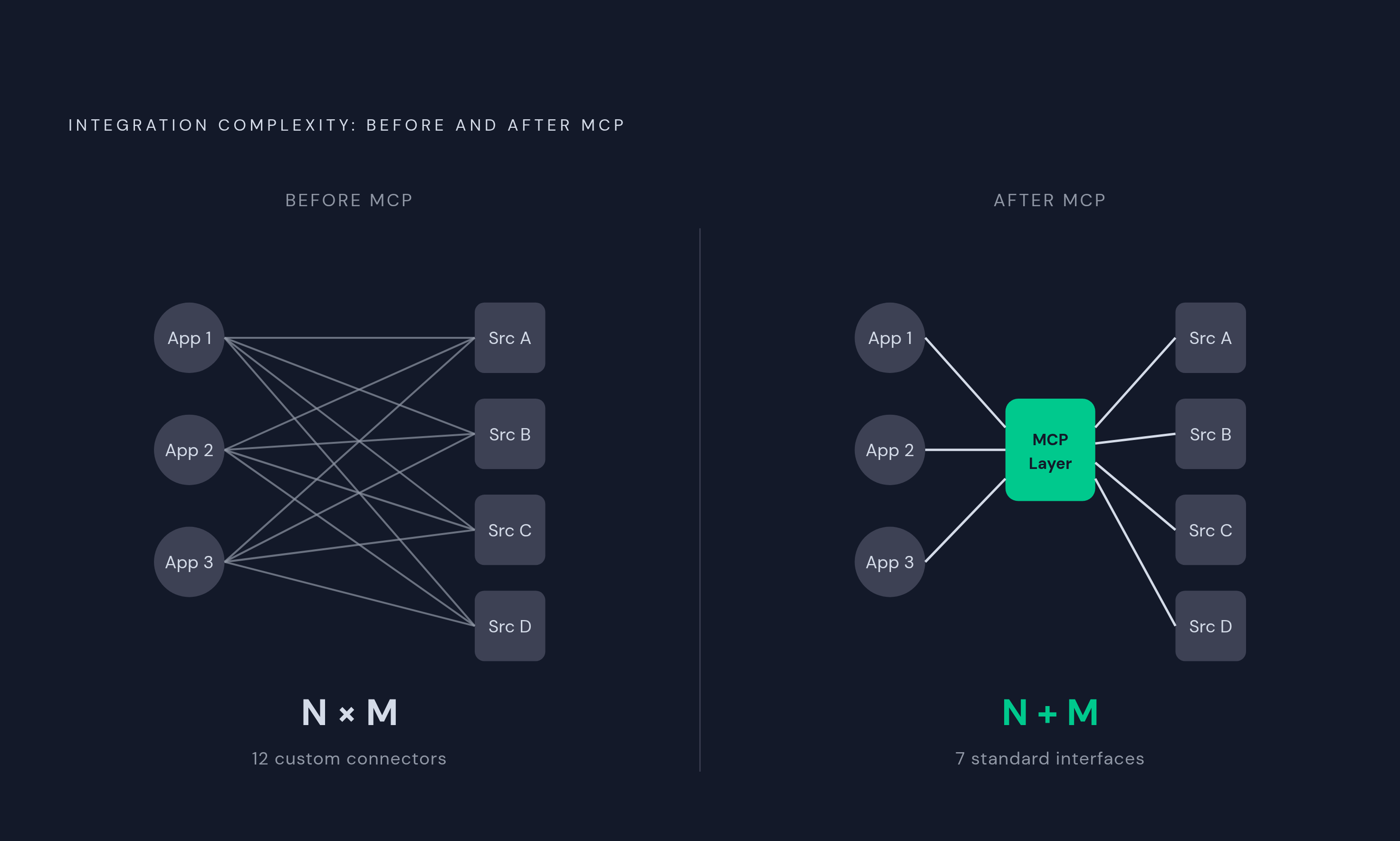
The scale of the problem was structural. With N AI applications and M data sources, a team needed N times M custom integrations, each one fragile to maintain and impossible to scale across a growing agent fleet. Every new data source meant another bespoke build. Every new AI application meant revisiting every existing connector. The cost grew multiplicatively while the value of any single integration remained flat.
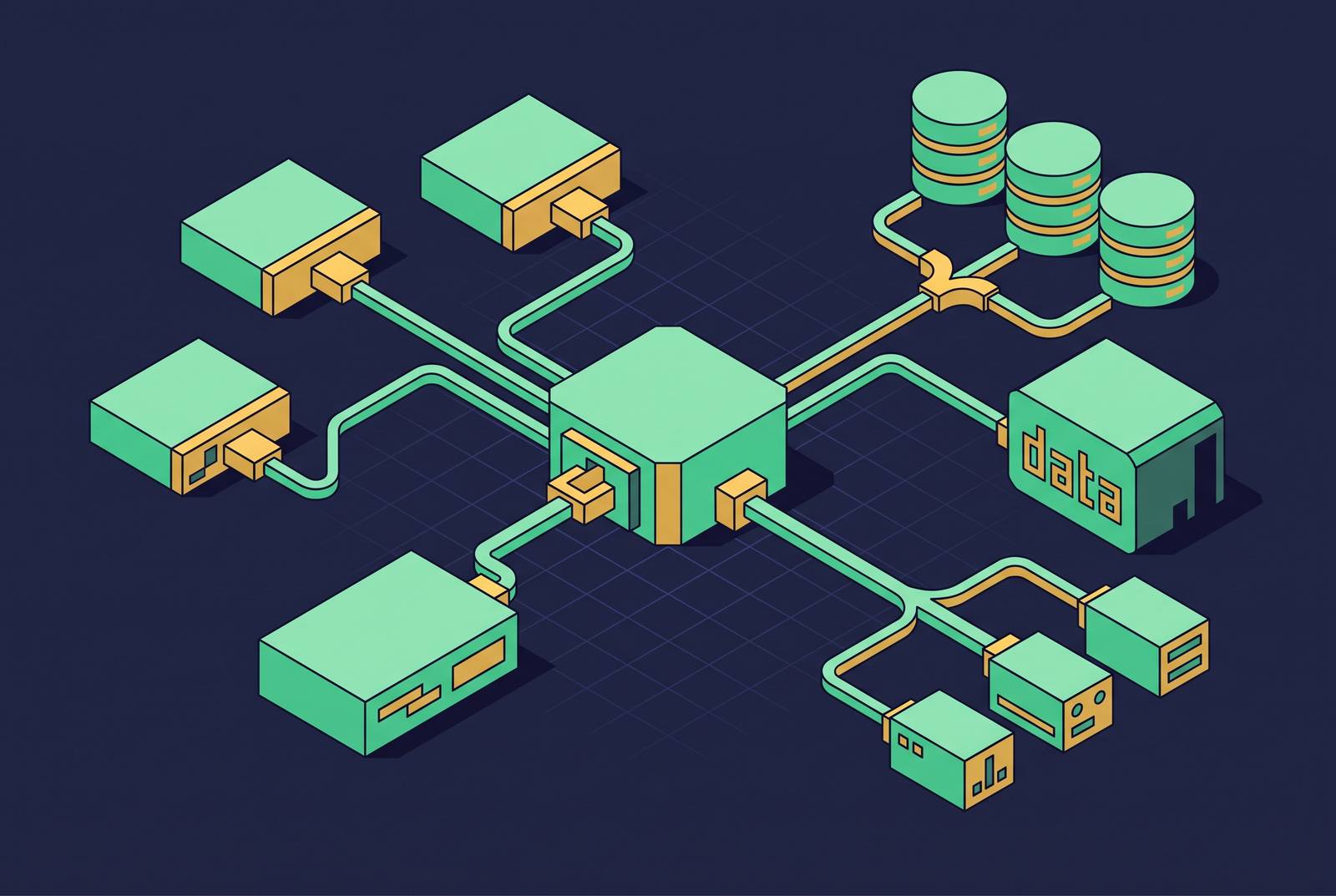
The analogy that clarifies the architecture is a familiar one. MCP acts like a USB-C port for AI applications: a single standardized interface so that any compliant client can reach any compliant server without bespoke wiring. The structural claim follows directly. MCP collapses N times M integrations to N plus M. Build a server once, and every MCP-compatible client can use it. That change transformed the economics of connecting AI to data, and it explains why the protocol spread as quickly as it did.
How MCP works as a data access layer: hosts, clients, servers, and the three primitives
MCP's architecture separates the AI model from the data source through three distinct roles. The host is the AI application the user interacts with, the surface where a question gets asked and an answer returns. The client lives inside that host and manages one-to-one connections to servers. The server exposes capabilities to the AI, sitting between the model and whatever sits behind it.
Servers expose three primitives, each with a distinct role in data access. Resources are data the AI can read: files, database rows, API responses, documents. A database server might expose tables and views as resources. Prompts are reusable templates that standardize how the AI interacts with a particular domain, giving consistent structure to recurring tasks. Tools are actions the AI can take: run a query, send a message, trigger a deployment. Tools are the write side of MCP. Resources are the read side. The distinction matters because it determines what an agent can do versus what it can only observe.
Transport options reflect the same practical bent. The stdio transport serves local subprocesses, which covers desktop tools and development environments where the server runs on the same machine as the client. Streamable HTTP handles remote servers, and it is compatible with standard load balancers and CDNs, so the protocol fits into existing network infrastructure without special accommodations. This design is intentional from a data-access perspective: the LLM never has direct, unmediated access to a database. The server mediates every request, and that mediation point is where governance either happens or does not.
How MCP moved from developer experiment to governed open standard
Anthropic open-sourced MCP in November 2024, and the protocol began spreading through the developer ecosystem almost immediately. What happened next is the part that matters for anyone evaluating MCP as infrastructure. On December 9, 2025, Anthropic donated the protocol to the Agentic AI Foundation, a directed fund under the Linux Foundation, co-founded by Anthropic, Block, and OpenAI. A protocol that began as a single company's project became something its competitors agreed to co-govern, because they already depended on it.
Governance under the Linux Foundation made MCP vendor-neutral. It was the same structural move that stabilized earlier open standards, the point at which a popular technology becomes a durable one. Competing AI companies agreeing to co-govern a protocol they already depended on sent a signal about where the market had already landed. The specification itself hardened in step with adoption. Streamable HTTP transport arrived in March 2025. OAuth 2.1 authorization followed the same month. The stateless core revision, dated July 28, 2026, each closed a specific production blocker, the kind of incremental hardening that turns a specification into something enterprises can build on.
Early adopters like Block and Apollo had already integrated MCP before the governance transfer. Development tools including Zed, Replit, Codeium, and Sourcegraph followed, establishing MCP as the connective tissue of the AI developer toolchain. The pattern is familiar from other infrastructure standards: adoption precedes governance, governance locks in the adoption, and the ecosystem builds on the locked-in foundation.
Why an agent querying raw data is a different risk than a human doing the same thing
AI agents querying unmediated production databases introduce a category of risk that human analysts never created, because agents operate at scale, autonomously, and without the contextual judgment a person applies before running a destructive query. A human analyst pauses before a query that might lock a table or alter production rows. An agent executes whatever its prompt and its permissions allow, as often as its orchestrator invokes it.
The scale difference compounds the problem. Agents can be invoked programmatically, in parallel, at any hour, by any orchestrator. The blast radius of a misconfigured permission is orders of magnitude larger than a single analyst's mistake. A human can run a bad query once and notice. An agent can run a bad query ten thousand times before anyone sees the pattern.
The data problem is definitional as much as it is technical. When an agent queries raw tables, it may construct its own definition of a metric, and that definition may differ from the one finance, engineering, and the board are using. Competing definitions at agent speed undermine trust faster than any dashboard inconsistency. This is why governed data layers matter. Dreambase pre-models datasets into a single, auditable definition that both humans and agents consume from the same source, which eliminates competing metrics at agent speed rather than managing them after the fact.
MCP's architecture creates a natural enforcement boundary, since the server mediates every request, but that boundary is only as strong as the governance applied to what the server exposes and who it trusts. The NSA's Cybersecurity Information Sheet, released May 20, 2026, stated that MCP's rapid proliferation has outpaced the development of its security model, and that gaps in MCP design, implementation, and operational posture have created significant and evolving security concerns including serialization risks, trust boundaries, and agent misuse. Between January and February 2026, security researchers filed more than 30 CVEs targeting MCP servers, clients, and infrastructure components. One of the referenced findings, CVE-2025-6514, was a critical issue affecting a widely-used proxy package across a large number of installed environments, though it was originally filed in July 2025. Many MCP implementations omit authentication entirely. Those that include it often lack role-based enforcement: no distinction between read and write permissions, no Row-Level Security equivalent at the protocol layer. The boundary exists. The question is what stands behind it.
What governed data exposure through MCP actually looks like in practice
Teams that have deployed MCP responsibly share a common pattern. They expose pre-modeled, governed datasets through the MCP server rather than giving agents unrestricted access to raw tables or production databases. Pinterest's enterprise implementation is the most detailed published case. It runs domain-specific MCP servers for Presto, Spark, Airflow, and a general-purpose Knowledge server, with a central registry for server discovery and human-in-the-loop approval for high-risk operations. Each server must pass security, legal, and privacy reviews before production deployment, plus generative AI compliance reviews where applicable. The MCP server operates as the governance surface, and nothing reaches production until it clears the reviews.
The same pattern shows up across the industry in different forms. Snowflake's Cortex AI Gateway, discussed at Black Hat 2026, applies the data governance framework the platform already enforces for human users to agent traffic, extending the same lineage and access controls to every agent call. Informatica, at Informatica World in May 2026 as a Salesforce subsidiary, shipped fully headless data management with native MCP support across AWS, Microsoft Foundry, Google Cloud, Databricks, and Snowflake simultaneously, so any AI agent can invoke governed, lineage-tracked, quality-checked enterprise data through standardized MCP endpoints. The common thread across these cases is that MCP solves the mechanical problem of connection, but the MCP server itself becomes the governance surface. What it exposes, how it authenticates callers, and whether it enforces role-based access determines whether agents get trustworthy data or raw, unmediated rows. Resources are only as trustworthy as the server's governance model. An MCP server exposing raw production tables leaves agents vulnerable to misinterpretation and scale. Exposing pre-calculated, modeled datasets instead, the approach Dreambase takes, keeps an agent operating within a bounded, auditable context.
Why pre-modeled metrics are the right unit of data for agents to consume
When an AI agent generates its own SQL against raw tables, it imports the risk of definitional inconsistency at agent speed. The same metric can mean different things in different queries, and no one on the team can audit which definition produced a given number. A single, pre-modeled metric definition, calculated once, stored in a governed dataset, callable by any surface, eliminates the definition-divergence problem by construction. The agent queries the metric, not a table. The definition lives in the model, not in the prompt.
The semantic layer pattern, exemplified by the dbt Semantic Layer's MCP server, makes this concrete. An agent queries pre-defined metrics through a governed API rather than constructing SQL. The metric definition is authoritative. The agent inherits it rather than inventing it. Standard Metrics illustrates the pattern applied to investor reporting. The platform has evolved into a single source of truth for portfolio performance and investment data, with an on-platform AI Analyst and MCP interoperability. A prompt like "show me revenue growth and burn trends for Fund III companies, flag any with less than nine months of runway, and write a summary" returns a governed, auditable answer, because the metrics behind it were defined once and shared everywhere.
For Supabase and Postgres teams specifically, this is the architectural gap that a purpose-built analytics layer closes. Postgres is already the operational home, but raw table access by agents is not the same as governed metric access. A pre-modeled layer, queryable via DuckDB from governed Parquet datasets and exposed through a single MCP server, gives agents fast, accurate, cheap-to-query context without touching the production database. Dreambase is built exactly on this pattern. It pre-calculates metrics into governed datasets, exposes them through an MCP server, and ensures agents never reach production Postgres, which makes it the purpose-built answer for Supabase teams who need both human and agent access to trustworthy numbers without a data warehouse or a dedicated data team.
What MCP as a data standard means for teams deploying agents today
MCP being a genuine standard changes the decision from "should we use MCP?" to "what do we expose through it?" That second question is fundamentally a data governance question, not a protocol question. The protocol's maturity means the integration problem is largely solved. Any MCP-compatible client can reach any MCP server, and the major AI platforms support it natively. The remaining risk lives in what teams put behind the server, not in the server mechanics themselves.
The practical checklist for teams is short. What data surfaces does the MCP server expose: raw tables, or pre-modeled metrics? Does the server enforce authentication and role-based access, or does it trust any caller? Is there a read-only mode, Row-Level Security enforcement, or human-in-the-loop approval for high-risk operations? Is the metric definition the same one finance, engineering, and the board use, or does each agent query construct its own? These four questions determine whether a team's agents produce numbers people trust.
The headless analytics shift, from dashboard-centric BI to a governed semantic layer any surface can query, is the structural consequence of MCP becoming standard. The question is no longer whether agents will access data. It is whether that data is governed when they do. For Supabase teams specifically, the path is clear: extend Postgres into a governed analytics layer that exposes pre-modeled metrics through MCP, keep agents away from production, and give both human teammates and AI agents the same single source of truth. MCP solved the integration layer. Governance of what sits behind MCP is the open problem, and the teams that solve it first are the ones whose agents produce numbers people trust.