Analytical Query Isolation Patterns for Supabase Projects
Guard analytical queries with access controls and replicas, not production credentials.
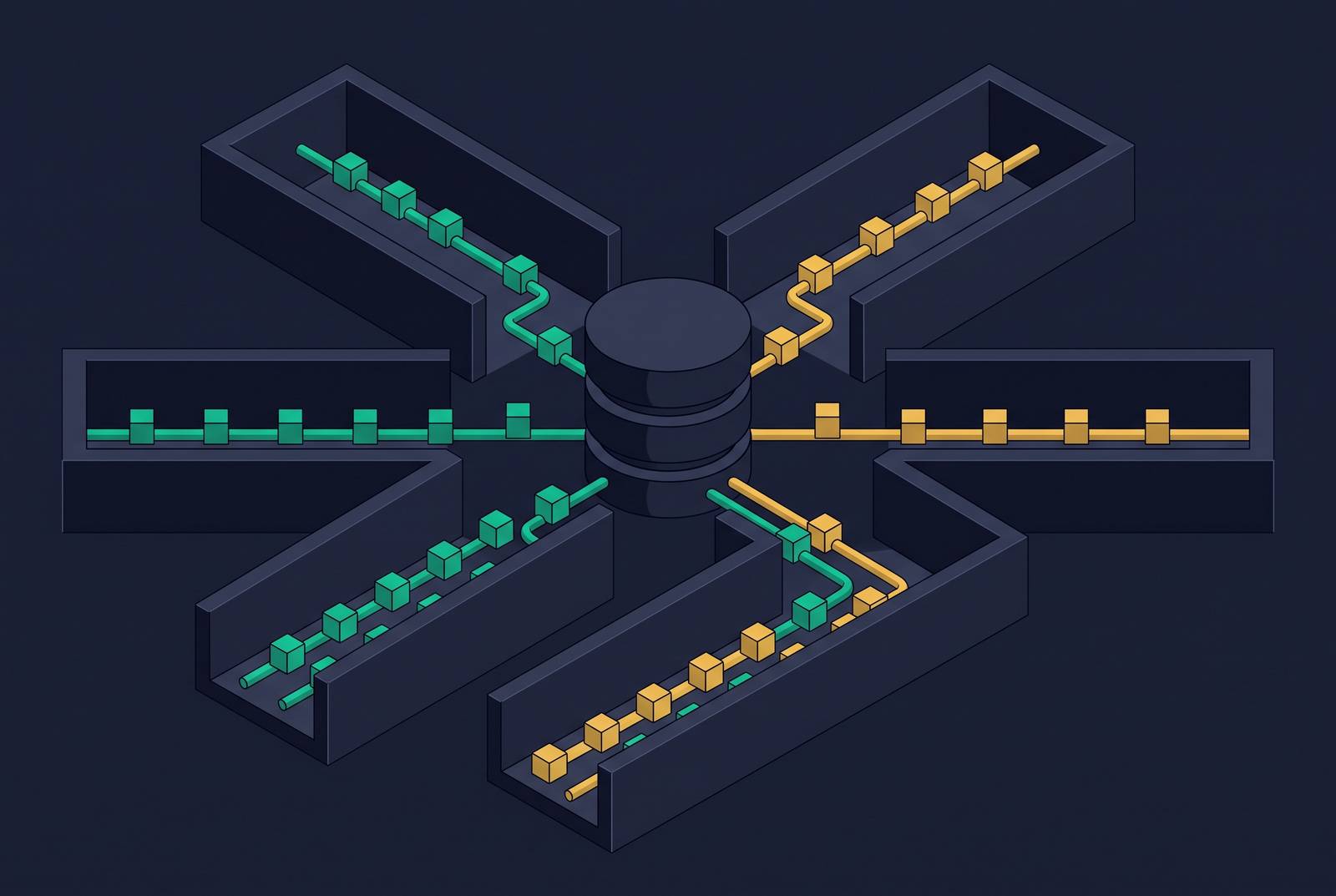
If an AI agent queries a Supabase database directly, with production credentials, the architecture is wrong no matter how carefully you write the prompts. The safer pattern is to pre-model the data into governed, access-controlled datasets and expose those to the agent through a Model Context Protocol server, so the agent holds no live connection to the transactional database. This piece maps the isolation layers that make that true, from Row Level Security to read replicas to the pre-modeled dataset pattern that firms like Dreambase have built specifically for Supabase teams.
Why analytical queries threaten production stability on Supabase
A founder ships fast on Supabase, gets some traction, and within a few months the CEO asks for a dashboard: cohort retention, a revenue roll-up, maybe a funnel broken out by signup source. Someone writes the SQL, points it at the production database because that's where the data lives, and the query runs. It also runs again next week, and then a teammate asks for a version with a different date range, and soon there are three or four of these queries firing against the same Postgres instance that's serving the app.
That instance was built for a different job. Analytical queries ask something different. OLTP workloads are transactional, row-keyed, fast, and narrow, while OLAP workloads are analytical, column-heavy, and slow and wide, and row-oriented storage is the wrong shape for columnar aggregation no matter how well Supabase tunes the database.
The consequence isn't just a slow dashboard. A heavy analytical query running on a production Supabase instance puts pressure on the exact database the application depends on for its own reads and writes, and that pressure degrades the experience for every user hitting the app at the same time. And Supabase schemas lean heavily on JSONB columns, which most charting tools can't read natively, so multiple people end up writing their own extraction queries, each slightly different, each producing a slightly different number for what's supposed to be the same metric.
None of this is a mark against Supabase. The platform does what an application database should do. The mistake is treating it as the analytics layer too.
What "analytical query isolation" means in Postgres
Analytical query isolation means keeping scan-heavy, aggregation-oriented workloads from consuming the CPU, memory, and connections that production transactional queries need, at every layer from row access to compute to storage. It isn't a single switch or a single product decision.
Isolation operates on several levels at once: which rows a query is allowed to touch (access control), which connection path it takes to get there (pooler configuration), which compute it actually runs on (the primary instance or a replica), and which storage format it reads from (row-store or columnar). If you get one of these right while ignoring the others, exposure still remains. A read replica built on row-oriented storage still runs slow columnar aggregations, just on a second machine. If Row Level Security has no indexed policy column, it still triggers sequential scans, and that degrades performance for every query hitting that table, policy or no policy.
The goal is to route analytical workloads to infrastructure built for them, while reserving the production primary for the short, row-keyed operations it does well.
Row Level Security as the access-control foundation
Row Level Security is the right tool for controlling what any role, human analyst, service account, or AI agent, can read from a Supabase database. It performs poorly under analytical load, so it works as a governance primitive, not a performance solution, and if you conflate the two you run into trouble.
Supabase's RLS pushes authorization into PostgreSQL itself. Before it returns results, the database evaluates a policy expression, an automatic WHERE clause of sorts, on every row, no matter how the query arrives. That's a real strength: access control holds even if an API layer gets misconfigured or an agent tries to route around application-level guards, because the database enforces the rule at the lowest level available. But that enforcement has a cost. If a policy references a column with no index on it, typically user_id or org_id, every policy check forces a sequential scan. On a table with a few thousand rows that's invisible. On a table with tens of millions, that's the gap between a query that returns in milliseconds and one that runs for minutes.
Analytical roles make the tension sharper. A BI service account or an agent that needs to scan across all organizations either needs a role that bypasses RLS entirely, which is a security exception the team now has to own and monitor, or needs analytics-shaped policies written directly into the production auth model, which distorts the auth model to serve a use case it wasn't designed for. Either path creates a problem that compounds the longer you leave it unaddressed.
There are also failure modes that tend to surface only when something has already gone wrong. A policy that runs a subquery against a multi-million-row table can sit fine in testing and then become the query someone is debugging at 2am once the table grows.
And the service_role key deserves a flat rule: it should never be used by a BI tool or an AI agent. That key bypasses RLS entirely, so it removes the only database-layer access control standing between a misconfigured query and every row in every table. A pattern for AI-driven analytics sidesteps this risk at the root: governed datasets served through a headless analytics layer, the approach Dreambase takes, let agents query pre-modeled, access-controlled datasets over MCP. RLS is necessary, it needs to be indexed, and it needs analytics-specific roles designed on purpose. It doesn't solve the compute or storage side of the problem.
Read replicas and materialized views: what they fix and what they leave unsolved
Supabase's own documentation recommends read replicas for complex analytical queries, keeping the primary free for user-facing operations, and that guidance is architecturally sound. A replica genuinely separates analytical load from the traffic the application needs to serve quickly.
The cost is concrete and worth sizing up front. A replica runs at the same compute size as the primary and bills for it separately. Plan compute credits apply to primary compute on the same invoice but not to replica compute, and the replica's disk runs larger than the primary's size. In practice, adding a replica roughly doubles database spend.
The replica's compute and storage costs buy real separation from production traffic, but that separation has limits. It still can't see data living outside Postgres: nothing from Stripe, nothing from a CRM, nothing from any other source a growing business starts to depend on. JSONB friction doesn't go away either. A read replica is a second copy of the same shape of database, paid for twice. It's the correct move for production safety, but it isn't a complete analytics architecture on its own.
Materialized views solve a different piece of the puzzle. And someone still has to manage refresh schedules, staleness windows, and the dependency chains between views, and that work grows as the business adds more views.
Compute upgrades, read replicas, and materialized views are all legitimate tools for extending Postgres as the analytical home. Used alone, though, they shift the problem rather than resolve it, and none of them answer the cross-source questions a growing business inevitably starts asking: what does revenue look like next to churn, next to support ticket volume, next to marketing spend, when those live in three different systems.
Supabase Analytics Buckets and the shift in where analytical data belongs
Supabase's own product roadmap backs up the argument this piece is making. In 2025, Supabase shipped Analytics Buckets, object storage backed by Apache Iceberg and built for large analytical datasets, a format designed from the ground up for columnar reads.
That's a platform-level admission that the production database and the analytics layer are different destinations, built to do different jobs. Supabase could have kept pushing read replicas as the complete answer. Instead, it added infrastructure that only makes sense if analytical workloads belong somewhere other than the row-store, which is the clearest signal available that "just use a read replica" was never meant to be the final word.
Iceberg matters here as a format, not just as a name. It supports schema evolution, time-travel queries, and is queryable by columnar engines, none of which row-store Postgres offers. But they confirm the direction: separate the analytical data from the production row-store, and put it in a format built for aggregation.
Pre-modeled governed datasets for human and agent access
The most complete isolation pattern available runs aggregations on a schedule so that neither a human analyst nor an AI agent ever queries production at the moment a metric is requested. The aggregation runs once, on a schedule, and every downstream consumer, dashboards, reports, agents, reads the stored result.
That architecture solves more than performance. It enforces a single definition for each metric: one calculation, one inclusion rule, one source of truth. The same revenue number shows up on every dashboard and in every agent's response, which removes the kind of definitional argument that eats up an operating review: MRR calculated one way by Sales and another way by Finance, both technically defensible, neither matching the other.
The practical implementation usually takes the form of Parquet files queryable via DuckDB: columnar storage that aggregates fast, needs no persistent database connection to query, and is served from object storage. So that combination is cheap to query, safe to expose to outside tools, and easy to scale horizontally, because nothing holds a connection open against a single database.
Some teams build this by extending Postgres into a governed analytics layer themselves, pre-calculating metrics and modeling datasets that isolate analytical consumption entirely from the production instance. The worst outcome from a misbehaving agent under this architecture is a stale read, not a destabilized application.
Governing agent access to Supabase data
An AI agent holding production database access with no query isolation in place is an incident waiting to happen, not a performance tradeoff to tune later. Agents execute at machine speed, they don't self-limit how much CPU or memory a query consumes, and they can't reliably tell a safe read apart from a destructive operation when a prompt or a piece of ingested data points them the wrong way.
A safer pattern for agent-to-database access layers several controls together. Agents operate on a dedicated, read-only analytics role, never the service role and never the production application role. Agent identity gets carried as a JWT claim enforced by RLS, not as a bypass flag, so the database applies the same access control to an agent session that it applies to a human one. Every prompt-to-query pair gets logged, you score a sample for faithfulness against the underlying data, and alerts fire when the pattern drifts.
MCP gives this architecture a natural boundary you can enforce against. MCP draws a clean line between read-only resources and callable tools, and that distinction is the right place to put the analytical isolation boundary: agents should reach data through resources, meaning safe reads from governed datasets, and never through tools built to touch production writes. The MCP spec revision dated 2026-07-28 drops protocol-level session tracking, which makes MCP-connected data tools horizontally scalable behind a standard load balancer, a detail that matters once an organization is running multi-tenant agentic deployments. At the furthest end of the isolation spectrum, some teams move pre-calculated, modeled datasets entirely outside the production schema and serve them through a separate analytics layer; Dreambase does this by pre-aggregating metrics and exposing them via API and MCP, keeping the query evaluation burden off production.
Choosing the right isolation layer for where your Supabase project is
The right isolation pattern is the one that matches a team's current query volume, data complexity, and whether agents are already in the loop, not the most elaborate architecture available.
Teams asking their first analytical questions, with no recurring workloads yet, should use the Supabase SQL editor directly. It's already there, it works for one-off questions, and it doesn't require standing up new infrastructure. Resist the urge to point a BI tool at the production primary just because a stakeholder wants a recurring view. If that request comes in, treat it as the signal to plan the next layer.
Teams with recurring dashboards, several stakeholders, and maybe an early agent experiment or two should add a read replica for analytical queries, which Supabase recommends explicitly and which genuinely separates analytical load from production traffic. And no agent should ever be handed the service_role key; a dedicated read-only analytics role with enforced statement_timeout limits needs to exist before an agent touches the database.
Teams running agents in production, reporting board-ready metrics, and fielding cross-source questions have outgrown what Postgres alone can give them. Dreambase provides this full stack for Supabase teams, pre-modeling, governed datasets, DuckDB queryability, and MCP exposure, without requiring a dedicated data team, a data warehouse, or any change to the existing Supabase schema.
What holds the whole map together is the discipline of one metric, one calculation, one governed place that every dashboard and every agent draws from. That shared definition is what lets a human analyst and an AI agent trust the same number, and that trust is the actual output every isolation pattern in this piece has been built to protect.