Governance Enforcement Layers That Stand Between AI Agents and a Live Supabase Backend
Four database layers must work together to safely govern AI agent access to production Supabase.
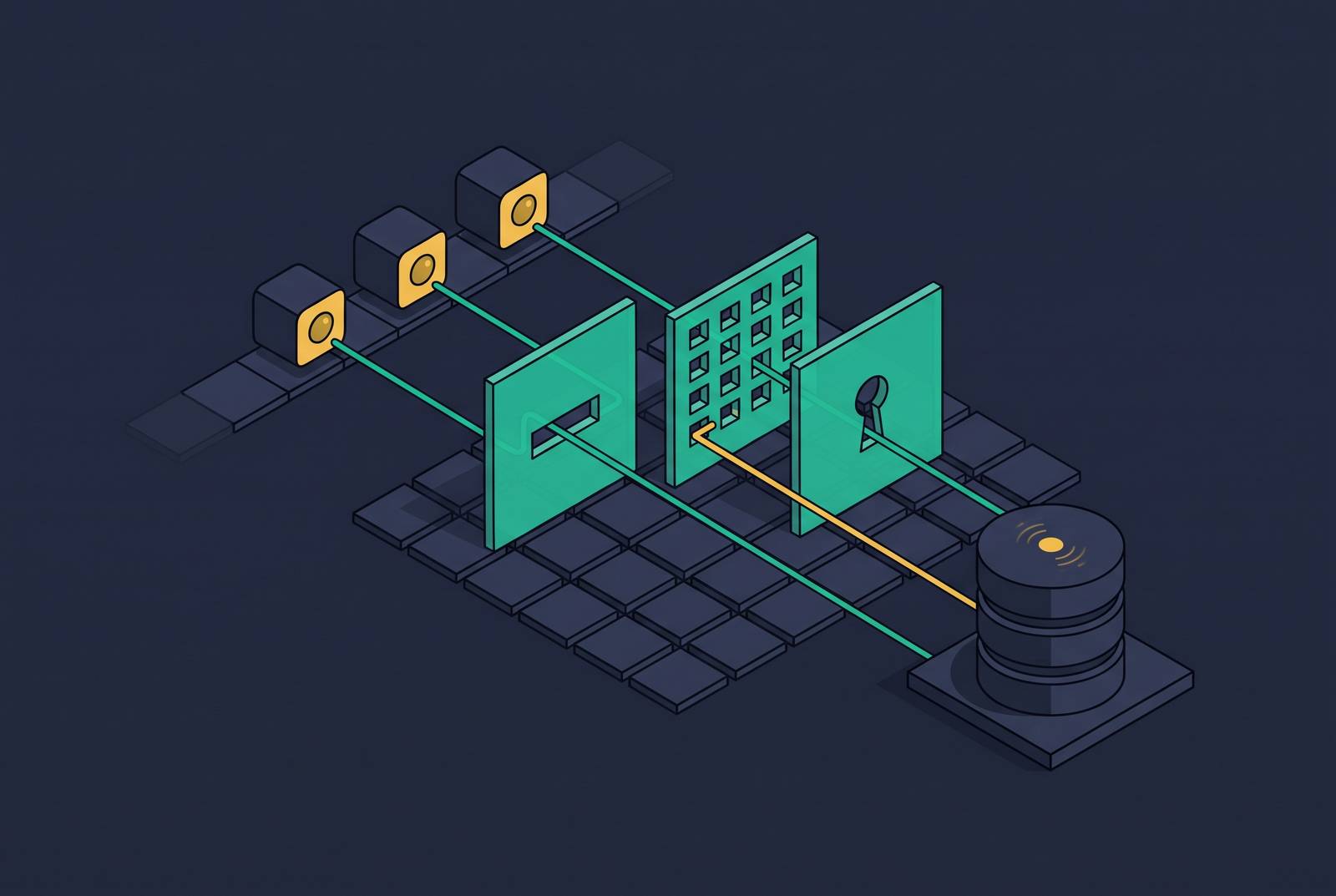
Governed data access for AI agents on Supabase via MCP requires four enforcement layers, namely scoped roles, correctly configured Row Level Security, proxy-level query controls, and a governed analytical read layer. Agents should use these layers to reach approved datasets and controlled operations, with no unrestricted access to production. Each layer blocks a risk that the others cannot, from authorization bypass that goes unnoticed to analytical workloads that use up production connections.
Why AI agents and live Supabase backends are a dangerous combination by default
Supabase’s April 2026 release post documents agents skipping RLS policies on exposed schemas and creating views without security_invoker = true, silently bypassing row-level protection. The same release describes agents hallucinating CLI commands and ignoring documentation in favor of training data that may be months out of date. These failures do not necessarily produce useful errors. A database operation can seem to work even when the access boundary the developer expected is missing.
Credential choice compounds that mismatch between appearance and enforcement. The service role key maps to an internal identity that bypasses RLS when requests carry no valid end-user session token, which is how most agent connections operate. A team can therefore write tenant policies and still give an agent a connection that does not obey them. The policies exist, but the agent’s access path defeats them.
Supabase’s agents page describes an MCP server supporting both read and write operations. Through one authenticated pathway, an agent can inspect schemas, insert records, and alter data. That reach is useful, but authentication alone does not distinguish a legitimate request from an unsafe one. Because coding agents can create databases faster than people review them, the enforcement gap is structural. Credential boundaries, row policies, statement controls, and workload separation address different parts of it.
What the service role key actually does to your security posture
Handing an agent the service role key removes RLS from its normal access path. The important exception is a request that also carries a valid end-user session token, in which case the user’s policies apply instead. Without that token, the service-role identity bypasses RLS. This distinction makes the effective request identity more important than the mere presence of policies in the database.
The agent should start with a dedicated, least-privilege Postgres role scoped to the tables and operations it legitimately needs. It should have no admin grants or broad service-role access. An agent that needs to read selected data does not need authority to modify that data simply because the same interface supports writes.
Column privileges narrow the reachable surface further. Postgres allows SELECT grants on explicit column lists rather than whole tables, excluding fields such as password hashes, billing references, and PII from the agent’s access. This credential boundary keeps the excluded fields outside the role’s permissions even when the agent generates a query that asks for them.
A correctly scoped role also needs a distinct identity. When agents, background jobs, and scripts share one connection string, database audit logs cannot reliably tie their queries to individual tasks. That ambiguity weakens incident response even if every participant has limited permissions. Least privilege defines what an agent may do, while a unique identity preserves accountability for what it actually does.
What Row Level Security enforces and what it cannot see
RLS enforces tenant boundaries and row-level authorization after the connecting identity has been properly scoped. It establishes a necessary boundary by determining which rows that identity may access for a permitted operation. RLS does not judge the request’s purpose or whether its scale is appropriate for the task.
A role with read access can still issue an unconstrained SELECT across every customer row its policies permit. If its column privileges also allow emails, addresses, and payment references, those fields can enter the model’s context window in bulk. RLS does not set a result limit or apply a field mask. Similarly, an agent with UPDATE access can omit a WHERE clause and update every row the policy allows, potentially the entire table.
Views need extra care because they normally run with the rights of their creator. That default can bypass policies on underlying tables without producing an error. The April release identifies security_invoker = true as a required setting for every view. It also documents that UPDATE requires a SELECT policy, with a missing policy causing the update to have no effect and generating no error. Both cases show why successful execution, or the absence of an error, is not proof of correct authorization.
Other database safeguards do not close the query-level gap. The pgaudit extension records statements after execution, so it cannot pause an unsafe statement in flight. IP allowlists establish network origin but do not restrain harmful commands after connection.
What a proxy layer stops that database permissions cannot
A proxy between the agent and the database can inspect statements in transit and block unsafe query shapes before execution. Unlike grants and row policies, it can distinguish a narrowly bounded update from one missing its WHERE clause. It can also intercept table drops and other destructive patterns.
For reads, the proxy can enforce a row-return limit and mask sensitive fields in result sets before they reach the model. An agent may legitimately have access to individual customer records without needing the entire authorized set in a single response. Result limits constrain volume, while masking controls what the response reveals.
For schema migrations, broad updates, and production writes, the proxy can hold a pending statement for review and approval by a named engineer. The database does not execute it until that approval is given.
The proxy can also log each statement with its originating agent identity and timestamp. That attribution restores visibility that a shared connection string alone cannot provide. Distinct, scoped database identities are still needed alongside it because attribution and authorization do different jobs. Together, they establish both who requested an operation and whether that operation was allowed to proceed.
Why the MCP server is a governance surface, not just a convenience interface
The MCP server exposes database capabilities as agent-callable tools, making tool configuration an access-control decision. Schema introspection, record insertion, and migration execution have different consequences despite sharing a protocol. The interface is not a neutral wire. Which tools an agent may call determines how much of the backend it can discover and change.
execute_sql allows arbitrary SELECT statements with no built-in row limit or field mask, while list_tables and column introspection show how the database is structured. Write and migration tools can insert, update, delete, and alter schema. Traditional DLP is outside this MCP path, so having it elsewhere does not show that tool responses are protected. Schema-level introspection must also be restricted where agents have no legitimate need, particularly around the auth schema.
The July 28, 2026 MCP specification revision makes protocol-level enforcement more tractable. MCP is stateless at the protocol layer, and method and tool names travel in the Mcp-Method and Mcp-Name HTTP headers. Gateways, rate limiters, and WAFs can therefore route and authorize traffic using headers without parsing JSON bodies. This lowers the need for bespoke inspection infrastructure, especially for teams without dedicated security engineering.
A gateway can govern access to a tool, while the proxy evaluates the SQL submitted through that tool and RLS governs accessible rows. For a team choosing an MCP server, the relevant criteria are therefore controlled tool access, restricted introspection, and an access path that preserves scoped identities and database policies.
How can agents query governed metrics without touching production Supabase tables?
A governed analytical read layer exposes pre-modeled datasets without sending agent queries to production Postgres. This keeps analytical work apart from live application traffic and gives agents approved metric definitions so they do not have to interpret raw tables. It addresses a different risk from unauthorized access. Even an analytical query that is properly authorized and structurally safe can use up resources that production needs.
MCP statelessness does not eliminate that resource constraint. Agents that query production directly can use up connection pools even when each query passes the inner controls. Adding MCP server instances does not remove the database bottleneck. Routing analytical traffic away from production removes those workloads from the contested connection pool.
The same separation creates a place to govern meaning. If different parts of a system define a conversion event, an active user, or retained revenue differently, an agent cannot resolve the disagreement by querying faster. It may return different answers depending on which table it reaches first. A semantic layer gives the model a definition set in advance, so it does not have to choose one for each request.
Pre-calculated, governed datasets let agents consume the same definitions as human dashboards. This is why the analytical read layer is not interchangeable with a read-only production credential. Read-only access prevents writes but leaves analytical load and metric interpretation unresolved. For analytics, the recommended path is an MCP interface to governed datasets, with production tables outside the agent’s query path.
The enforcement stack assembled: what each layer blocks and what happens when one is removed
Layer 1 is scoped roles and least-privilege credentials. It prevents agents from operating through an unnecessarily broad service-role identity and limits accessible tables, columns, and operations. Removing it can make carefully written RLS policies irrelevant because the connecting identity bypasses them. A unique agent identity also keeps database-level attribution useful rather than blending agent activity with unrelated jobs and scripts.
Layer 2 is correctly configured RLS with invoker-rights views. It enforces tenant and row boundaries within the role’s permitted surface. Without it, a scoped role has no row boundary set by a policy, while a view without security_invoker = true can bypass protection on underlying tables without any sign that it has done so.
Layer 3 is proxy-level query control with human approval. It blocks unconstrained bulk reads, updates without WHERE clauses, destructive schema operations, and unmasked sensitive responses reaching the model. Without it, queries that are allowed but ask for too much can still run. RLS may allow access to every affected row but cannot judge whether the statement does more than the task calls for.
Layer 4 is the governed analytical read layer. It separates analytical workloads from production connections and supplies shared metric definitions. Without it, even analytics checked by the proxy can compete with live traffic and use up connection pools. The three inner layers also cannot make metric definitions agree when they were modeled in conflicting ways.
Supabase’s agent skills framework expresses the same separation of responsibilities at the workflow level. It loads security requirements inline, separates tool access by risk, and directs schema changes to local or staging databases through execute_sql or the CLI. Advisors run before changes are formalized as migrations. Those instructions support the enforcement stack, but they do not replace the technical gates that constrain execution.
The operating contract is narrow scope, short-lifetime credentials, branch-first execution, diff-first review, and human approval before production. Each term requires a control that can enforce it.