Headless Analytics Architecture and the MCP Data Layer
Shared metric definitions and governed data make MCP answers trustworthy.

Headless analytics architecture gives API-first and agent-first teams control over presentation by separating analytics logic from any dashboard UI. The right backend exposes shared metric definitions and governed datasets through APIs and MCP, keeping agent requests away from production. MCP makes the backend reachable across applications, but pre-modeled data makes its answers trustworthy.
Why analytics infrastructure is disaggregating now, and what headless means precisely
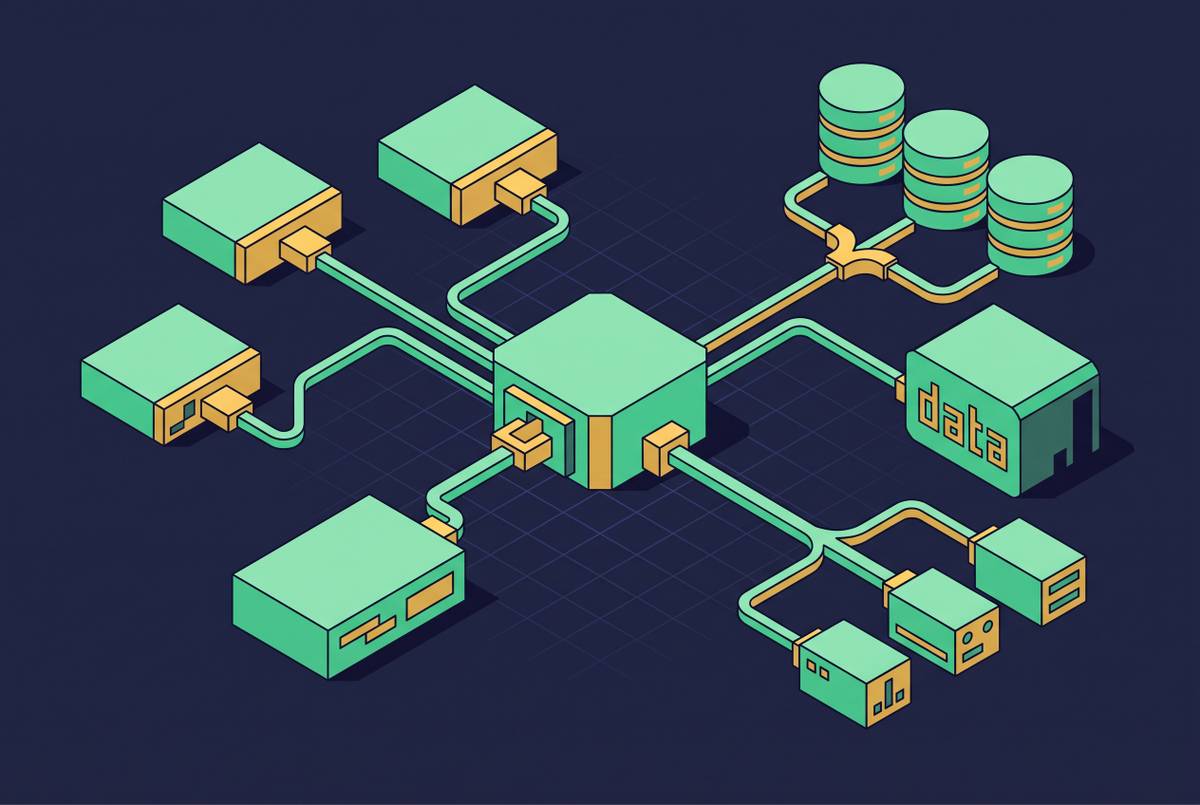
Traditional BI puts data, logic, presentation, and delivery in one tool. Metric definitions sit within that tool’s interface, inaccessible to outside consumers. Headless BI separates the analytics logic layer, including metric definitions, business rules, SQL, and data models, from presentation. The interface becomes interchangeable. Dashboards, Slack bots, AI agents, and spreadsheets can draw from the same governed backend, much as headless commerce separates the storefront from the commerce engine.
Three forces explain the shift in 2026. Dashboards are no longer the default interface, while specialized tools in composable stacks often calculate the same metric differently. Teams consequently spend time reconciling answers, delaying decisions. A semantic layer moves that consistency into infrastructure. Agents also need programmatic access to metrics rather than a dashboard, and direct database access creates problems with governance and accuracy.
The resulting architecture has four distinct layers. The Data Substrate holds verified, permissioned, refreshable data with documented provenance. The Reasoning Layer supplies semantic schemas, governed context, and metric definitions, with its model-independent defensibility coming from proprietary business logic. The Delivery Layer makes that intelligence reachable, historically through a portal and now through an MCP endpoint. The Decision Layer turns intelligence into action with an owner and an outcome. Who owns these layers shapes who is responsible and who can compete, while MCP lets AI applications use the new delivery layer.
What MCP actually is and how its architecture works as a data access standard
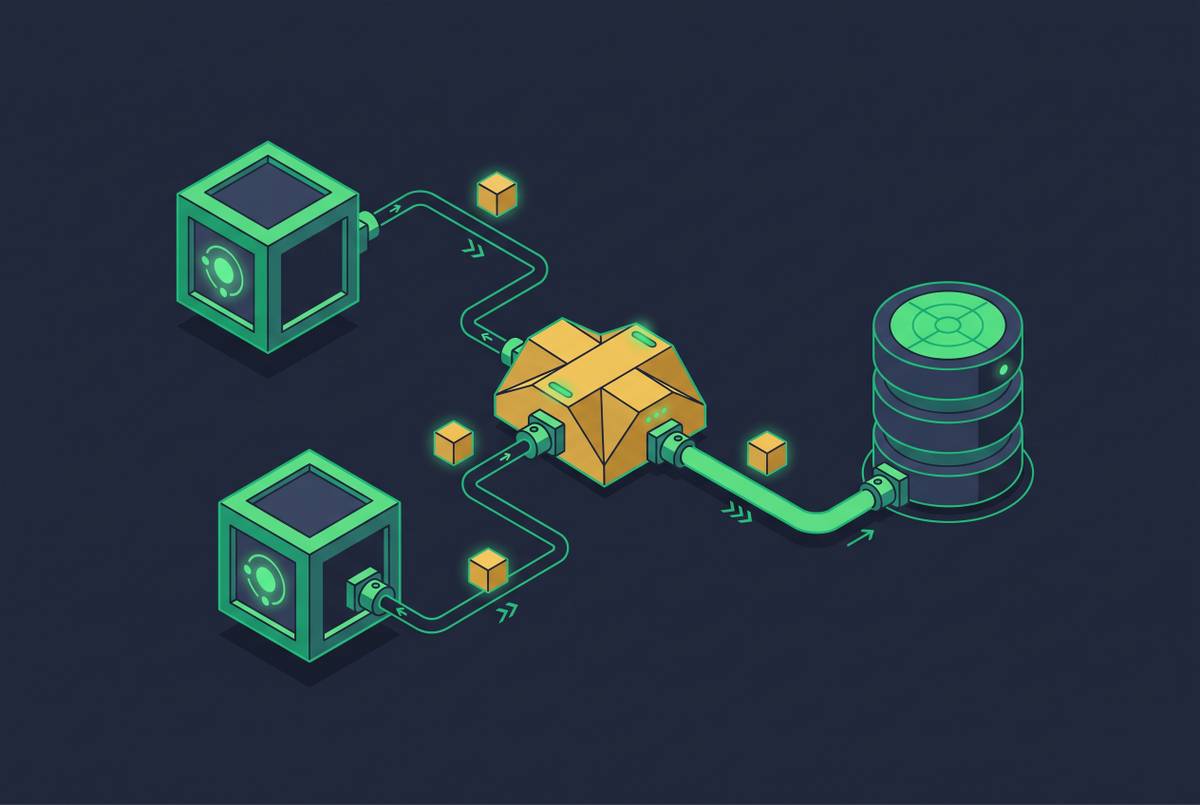
The Model Context Protocol, or MCP, replaces N×M application-to-source connectors with N+M implementations of a common protocol. It separates three roles with distinct responsibilities. The Host is the application a user interacts with, such as Claude, ChatGPT, Cursor, or a custom agent. A Client inside that host negotiates the protocol and routes requests. The Server exposes capabilities through a standard interface that the host can discover and use.
Servers expose three primitives for different analytical purposes. Tools do things such as run a query, while Resources give agents context such as schemas and governed datasets. Prompts supply reusable templates for repeatable analytical workflows. Together, these primitives expose more than data retrieval. They give an agent the context and workflow needed to use the available data correctly.
Anthropic introduced MCP in November 2024 and donated it to the Agentic AI Foundation under the Linux Foundation in December 2025. Support across Claude, ChatGPT, Gemini, Microsoft Copilot Studio, and Cursor established a shared integration surface across competing platforms. The 2026-07-28 specification made MCP stateless at the protocol layer, retiring the initialize/initialized handshake and Mcp-Session-Id header. Each request has its protocol version, client identity, and capabilities in its metadata. The same revision formalized extensions covering Tasks, MCP Apps, and Enterprise Managed Authorization, and hardened authorization through RFC 9207 issuer validation.
With statelessness, there is no need for protocol session affinity. Requests can go to any server instance behind a plain round-robin load balancer, with no need to share storage for protocol context. Multi Round-Trip Requests support mid-call confirmations or missing parameters by returning an input_required result, after which the client retries with answers attached. This takes the place of server-initiated requests without having to keep a stream open. However, scaling the MCP server does not expand the underlying database’s capacity, so agents querying production Postgres can still exhaust its connection pool.
Why enterprise platforms have already moved to headless MCP architectures
Salesforce Headless 360, announced at TrailblazerDX on April 15, 2026, exposes Salesforce data, workflows, and business logic as APIs, MCP tools, or CLI commands without requiring a browser. It shipped more than 60 new MCP tools and 30+ preconfigured coding skills at launch. Engine reported deploying production-ready AI agents in 12 days using the Agentforce layer. For teams seeking programmatic access to Salesforce capabilities, Headless 360 is the relevant enterprise example.
Informatica announced fully headless data management through native MCP support at Informatica World 2026 on May 20, 2026, in Las Vegas. Core IDMC capabilities, including metadata search, data quality checks, address validation, lineage tracking, and MDM operations, were decoupled from the GUI and exposed through MCP endpoints. Its use case is enterprise data management. MCP servers were live or entering preview across AWS, Microsoft Foundry, Databricks Agent Bricks, Snowflake Cortex AI, Google Cloud, and Salesforce Agentforce. Tableau addresses a different need, exposing governed Tableau knowledge through a cloud-hosted MCP server across Claude, ChatGPT, Slack, Teams, and Salesforce.
These platforms also show why access and governance belong together. Theodora Bakker, VP of Data at The Hearst Corporation, framed headless architecture as a security play because production agents expand exposure to data leaks, prompt injection, and new threat vectors. When policies are decoupled, the same governance can work across agent surfaces. Salesforce and Informatica introduced the Agent Fabric Context Catalog to unify governance over AI agents and enterprise data assets. The enterprise pattern is therefore not simply removing the interface, but making governed capabilities available outside it.
The specific ways an ungoverned MCP data layer breaks for agents and humans alike
Metric drift starts when those who use the same data read it in different ways. One engineer writes SUM(revenue), while another writes SUM(amount_captured), and Q2 revenue depends on which query runs. Both queries may read correct underlying records. An agent connected directly to tables creates another interpretation unless a shared semantic layer constrains what the metric means.
For Supabase and Postgres teams, direct agent queries risk connection-pool exhaustion and row-level security bypass. These are workload and permission-boundary problems. Separating analytical traffic at the data layer fixes the production bottleneck that scaling the protocol leaves in place. A governed analytical copy keeps agent requests away from the transactional instance.
MCP infrastructure also has its own security exposure. The mcp-remote proxy package was affected by CVE-2025-6514, with a CVSS score of 9.6.
The 2026 CDO Survey found that 76% of data leaders say governance has not kept pace with AI adoption. That gap appears operationally as ad-hoc islands of analysis. Each live query can embody its own definition, without shared version history or a way to audit why two agents returned different numbers. People who use their own calculations run into the same trouble. They lack a reusable dataset with its meaning and access rules set before either consumer asks a question.
Why pre-modeled, governed data is the only kind agents and humans can share reliably
For shared analytics to be reliable, they need a pre-modeled, pre-calculated dataset in place of a live query that each consumer writes on its own. A dashboard and an agent can return the same number when both consume the same governed definitions. Governance therefore extends beyond permission to read data. It establishes what the data means and enforces that interpretation at the infrastructure level. Access control alone cannot make two competing definitions of revenue agree.
A semantic layer defines entities such as customers, orders, products, sessions, and campaigns. It also defines metrics such as ROAS, LTV, CAC, AOV, and conversion rate, together with dimensions such as date, channel, geography, customer segment, and product category. Relationships specify how entities connect to one another. Calculations establish precise formulas, while filters determine what is included or excluded by default. The semantic layer sits above the data store and defines interpretation, leaving storage to the data store.
The safe access pattern places a governed analytical copy behind the MCP server. Pre-calculated datasets, such as governed Parquet files queryable through DuckDB, provide fast, accurate, cheap-to-query context without production connection-pool pressure. Agents discover available datasets and request them by name through Resources and Tools. No queries from agents reach the production instance. This separation makes the analytical copy both the workload boundary and the place where shared definitions become consumable.
Salesforce’s Data 360 MCP Server illustrates a complementary facade pattern. It exposes search, payload_examples, and execute instead of placing roughly 200 underlying operations into the agent’s context at once. Implementations should cache stable capability descriptions, constrain search to the user’s role, and log the selected operation, payload shape, identity, and result status. Discovery remains compact while operations remain auditable. With governed datasets behind that interface, one MCP server can serve both human teammates and AI agents without giving either a separate interpretation of the business.
How do Supabase teams get raw API access without a separate warehouse?
For Supabase teams, Postgres is still where analytics happens, serving as an analytics store in its own right. The implementation goal is to extend it into an analytics capability without ETL, schema changes, or new infrastructure. That does not mean sending every analytical request to the primary. Raw API access describes control over the interface. It does not require raw access to transactional tables or an opinionated dashboard frontend.
Teams need observability before they add more analytical query load. Connection limits, bad indexing, chatty queries, and misuse of realtime subscriptions can undermine transactional performance. pg_stat_statements, preloaded but not always fully enabled on several major managed Postgres providers, records mean query time, total time, and call count. Supabase’s Metrics API exposes roughly 200 Postgres performance and health metrics in Prometheus exposition format. Together, these provide visibility into query load and database health.
Teams building this architecture should start with alerts for six conditions. These are active connections approaching max_connections, cache hit ratio falling below target for hot data, low disk space, excessive replication lag, long-lived idle-in-transaction connections, and p95 query latency regressions on critical paths. Expensive repeated reads belong in materialized views or caches. Continuously growing tables call for cold-data archiving, while high-connection serverless workloads require connection pooling before analytical queries are added. These measures protect transactional performance while the analytical workload is separated.
For agent access, teams should pre-model metrics into governed Parquet datasets queryable through DuckDB. A single MCP server can expose those datasets, metric definitions, and scheduled reports with consistent permissions and auditability. Row-level security is still on the production instance. The analytical copy must enforce its own dataset-level access rules because production policies do not follow the data on their own. Supabase Multigres is a future write-scaling capability.
Choosing the right metrics to govern first, and why this matters before the architecture is in place
A technically sound governed layer can still go unused if it governs too many metrics or the wrong ones. Teams should start with a small set of actionable KPIs that drive decisions at the company’s current stage. For most B2B SaaS startups, those are CAC, LTV, monthly churn, ARR, and gross margin. Companies at an earlier stage need to focus more on activation, retention, and learning signals. Optimizing CAC efficiency or net revenue retention too early mistakes later-stage measurement for present decision support.
Each metric needs one named person, ideally the technical founder or a data lead, who has final authority over its definition. Without that owner, definitions can drift within weeks even with the technical layer in place. Delivery also requires a decision about which metrics deserve attention. The governed layer can push pre-calculated results to inboxes, Slack, scheduled reports, or a morning digest, but the team must choose what is worth pushing before building that pipeline.
The practical next step is to identify the five metrics that drive the business, assign owners, and build the governed layer around them before adding more surfaces.