MCP as the Visualization-Agnostic Interface That Keeps Analytics Infrastructure Honest
MCP exposes governed metrics and permissions so agents, dashboards, and APIs share one definition.
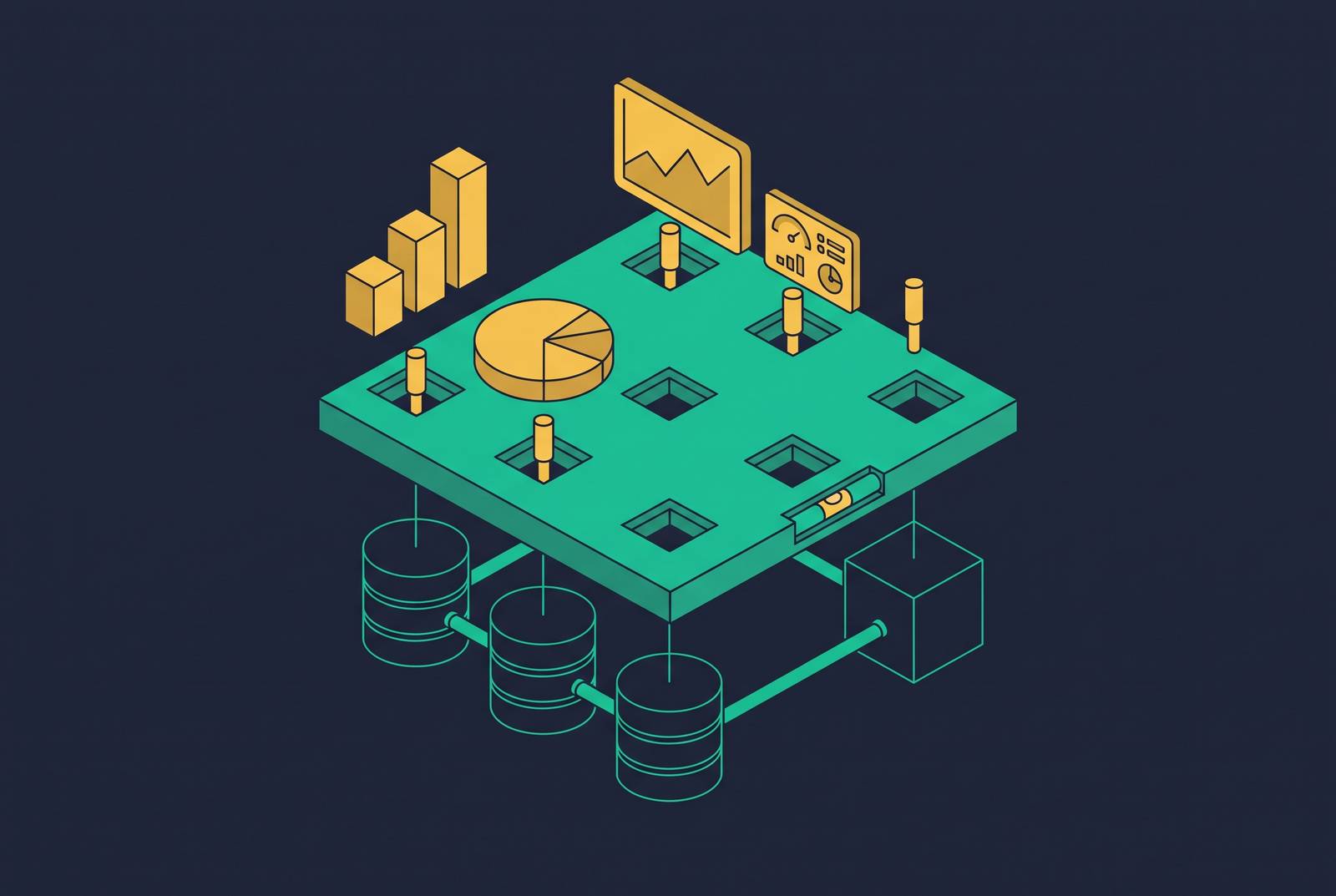
For API-first and agent-first teams, a headless analytics backend should expose governed metrics and permissions without requiring an opinionated frontend. MCP supplies the visualization-agnostic interface. It makes shared definitions and controlled access clear before agents, dashboards, or API clients use them.
Why analytics infrastructure needs a single point of truth now that agents are in the loop
One engineer writes SUM(revenue), while another writes SUM(amount_captured). Both queries can read records that are correct, but Q2 revenue changes depending on which query runs. Neither result necessarily raises a flag. A human analyst may remember that revenue means captured amount rather than invoiced amount, or ask a colleague to resolve the difference. An agent given those same tables has no shared definition to constrain its interpretation.
That ambiguity becomes an infrastructure problem when agents join analytical workflows. Without a semantic layer, an agent can construct an answer that is internally coherent but inconsistent with the number used elsewhere in the business. Faster querying then accelerates inconsistency.
Human judgment has often concealed this weakness. Analysts reconcile numbers through conversations, Slack messages, and knowledge that never becomes part of the data model. Agents expose the cost of leaving those agreements informal because they can repeat an unsupported interpretation across many requests. Metric drift is therefore not a new problem. It gets worse when analytical work moves faster than humans can run queries.
What MCP actually is and why its architecture matters for data teams specifically
Model Context Protocol, or MCP, replaces the need for a custom integration for every combination of agent framework and data source. Previously, each combination required its own authentication, formatting, and error-handling work. Tools take actions, such as running a query, while Resources provide context, including schemas and governed datasets. Prompts supply reusable templates for repeatable analytical workflows, so a server can expose both access and the context needed to use it correctly.
Anthropic introduced MCP in November 2024 and donated it to the Agentic AI Foundation under the Linux Foundation in December 2025. The 2026-07-28 specification made the protocol stateless at the protocol layer, retiring session affinity. That change separates scaling from session placement. A server in front of governed analytical data can scale horizontally without shared storage for session context, much like a REST API. But the database still has its own limits, including the connection pool that direct agent queries can use up.
The same revision hardened authorization through RFC 9207 issuer validation and deprecated Dynamic Client Registration in favor of Client ID Metadata Documents. Clients must validate a present issuer parameter against the recorded issuer before redeeming the authorization code. Dynamic Client Registration is still available for backwards compatibility until it is removed in a future version. The twelve-month minimum window belongs to the general deprecation lifecycle policy. These controls support governed access, but they do not define which data an agent should receive.
How the governed layer becomes the actual source of truth when no front end owns the definitions
In dashboard-first architectures, a metric definition can live inside a formula editor or a chart’s SQL. That makes the dashboard more than a presentation surface. It becomes an authority on what the number means, even when another dashboard implements the same metric differently. Someone without access to that tool, including an agent, cannot rely on its hidden definition. Adding more consumers does not change who owns the definition.
Headless BI moves metric definitions, entities, and calculations into a semantic layer separate from any visualization head. Dashboards, agents, and reports then consume that layer on equal footing. No frontend gets to redefine the metric. This is the governance value of visualization-agnosticism, rather than simply the convenience of choosing a different charting tool. If the system is to provide consistent answers without privileging one consumer, the definition must exist independently of every consumer.
MCP makes that separation operational, but it does not supply the semantic discipline itself. A server exposing unrestricted query actions against raw columns can preserve every ambiguity of the original architecture. A well-designed layer exposes governed datasets as Resources, so agents get pre-modeled, pre-calculated metrics. Tools remain the action mechanism, but their presence is not a substitute for an agreed analytical model.
The same logic applies to permissions. A dashboard filter that restricts visible rows cannot protect a separate agent interface unless the corresponding policy also governs that interface. Permissions must be set in the access-controlled layer. Otherwise, the system has centralized the meaning of a number while leaving who may see it dependent on the route taken.
What enterprises have built with MCP-governed analytics layers and what it reveals about the pattern
Informatica announced fully headless data management through native MCP support at Informatica World 2026 on May 20, 2026, in Las Vegas. It decoupled core IDMC capabilities from the GUI and exposed them through MCP endpoints, including metadata search, data quality checks, address validation, lineage tracking, and MDM operations. The interface changed, but the data management rules stayed the same. This illustrates the distinction between opening a new access path and creating a separate governing system. Agents gain access to existing governed capabilities rather than becoming responsible for reconstructing them.
Salesforce announced Headless 360 at TrailblazerDX on April 15, 2026, exposing data, workflows, and business logic as APIs, MCP tools, or CLI commands without requiring a browser. It shipped more than 60 new MCP tools and 30+ preconfigured coding skills at launch. Business rules remain available through the headless interface. For analytics, metric definitions must accompany access.
Tableau announced general availability of its MCP servers, an Agentic Analytics Command Center generally available in the fall, and deep integration of agentic coding capabilities. This announces a shift toward using analytics within workflows as well as for reporting. It is not evidence that every announced component has completed deployment. Taken together, these cases illustrate a common architectural order, with governed capabilities first, the MCP interface second, and the visualization or agent consuming them third.
That order requires investment before exposure. Pinterest’s per-server compliance review and Informatica’s lineage-first approach illustrate work that a connector alone cannot perform. Definitions, provenance, and access decisions need a home where someone is responsible for them before new consumers arrive. The enterprise pattern is therefore not simply widespread protocol adoption. It is the decision to treat the governed layer as the product and MCP as one interface to it.
Why direct agent access to production databases is the specific failure mode this architecture prevents
Production Postgres connection pools can be exhausted by direct agent queries even when the MCP server scales horizontally. More server instances scale the access layer, while analytical requests still converge on the same production database. This makes workload isolation a necessary counterpart to semantic governance.
Direct access can also bypass rules built for authenticated human sessions. An agent using broad credentials may read rows that no individual user should see, without an audit trail identifying that access as out of scope. Protocol authorization alone does not resolve that mismatch. Forrester’s AEGIS guidance treats agents as a new identity class requiring lifecycle governance and on-behalf-of delegation, and explicitly addresses Data Security and Privacy controls. It addresses provenance separately under Application Security and DevSecOps, reinforcing that identity, data access, and traceability need distinct treatment.
Supabase makes the operational stakes particularly clear. PostgreSQL is the single source of truth for its state, including user data, auth tokens, per-tenant Realtime subscription and broadcast metadata, and storage metadata. Exposing that production instance directly to agent traffic therefore places analytical demand against a central operational dependency. An MCP wrapper does not create workload isolation. The safe analytical pattern places a governed copy behind the server, with agents querying that copy rather than the production instance and with shared definitions and access controls in the governed layer.
How do teams build a governed MCP analytics backend before the first agent query?
Teams implementing this pattern should begin with modeling and policy. Inventory every source the agent will touch before building the interface. Set row- and column-level access rules before any connection exists instead of using live requests to find out where the limits need to be. Those decisions set the limits of what the analytical system can do. They also make explicit which permissions must hold regardless of whether the consumer is an agent, an API client, or a dashboard.
Next, pre-model and pre-calculate metrics into governed datasets that agents consume as Resources. Expose those datasets through an MCP server querying a governed analytical copy. The copy supplies the workload isolation boundary. Keeping policy and definitions there also keeps each agent’s configuration from holding a different version of the same rules.
For Supabase builders who need this architecture without assembling it themselves, the relevant backend pattern is a governed analytical copy pre-modeled into Parquet datasets, queryable via DuckDB, and exposed through a single MCP server. It gives agents the context they need for analysis without access to the production Postgres instance. The selection criteria are therefore concrete. A headless analytics backend needs shared metric definitions, explicit access controls, an isolated analytical workload, and access that does not depend on a prebuilt dashboard UI. Raw API availability by itself establishes none of those properties.
Finally, audit every query an agent runs. Query auditing is a feedback loop for the model. Repeated unexpected results can reveal a metric whose definition remains ambiguous. The response is to tighten the shared definition where that ambiguity originates. This keeps the correction available to every consumer instead of turning it into another instruction that only one agent knows.
Why pre-calculated, pushed metrics are the operational form of a governed layer for teams without a dedicated data function
For founders and small teams, even a trusted model leaves work to do if someone must remember to open a dashboard. The operational endpoint is a metric that arrives already calculated from governed definitions. Metrics should be pushed to the inbox, Slack, or phone at the right cadence. This lets people discuss performance without each having to run their own analysis first. Agent-generated reports can then draw from the same datasets.
The appropriate metric set also changes with the company’s stage. Pre-seed teams need problem validation, activation, and evidence of repeat usage, while seed companies need early retention and evidence that a customer segment will pay. Series A companies need a repeatable acquisition engine and improving unit economics. Governance means retaining shared definitions while surfacing the measures relevant to the decisions the team faces.
Those measures start with data the team can trust, scattered across product databases, payment processors, CRM, and spreadsheets. The governed layer brings that data into a shared analytical model so it becomes the first place people turn. For growing teams on Supabase, this is the architecture for operating with trusted numbers without a dedicated data team. The governed layer supplies the model, and MCP supplies the access interface. A human in Slack, an agent in a workflow, and a dashboard in a browser can all receive the same number, calculated from the same definition.